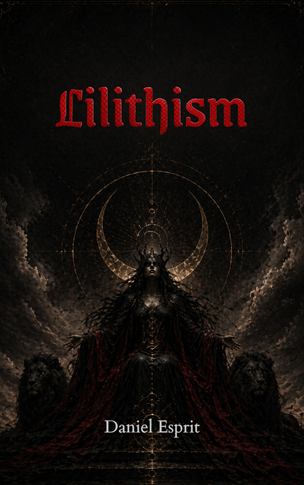
Lilithism
Everything in this book passes through Lilith. It asks what the gods are, what the cosmos was built to do, how the will is taken, and how the Qliphothic path returns it to itself. No rituals are given here; the grimoires that carry them are named at the end.
Chapter-by-Chapter Summary
Preface
Lilithism is presented as a teaching centered on Lilith as patron deity of a self-deification path. It gives cosmology, the architecture of the cage, the nature of the bond between human will and god, and the route by which that cage is dismantled. The text supplies understanding rather than ritual scripts, sigils, or step-by-step invocations. Its intended reader is the practitioner, or someone already close to practice, who has felt the pull toward the Nightside and needs a map of the territory.
Key terms: Lilithism, Lilith, self-deification, cage, Nightside, practitioner, map, understanding.
-
What Lilithism Is Not
Lilithism is separated from several nearby errors. Christian Satanism remains trapped inside the Christian cosmos, with Satan as a defeated adversary acting under divine permission. Atheistic Satanism preserves Christian inversion while stripping away metaphysics. Theistic Satanism gives Satan reality, yet still defines him through opposition. Wicca and Goddess spirituality dissolve the individual into nature, cycle, or Great Mother. Feminist Lilith domesticates her into a political emblem. Jungian psychology turns gods into projections. Religion adds institution, moral code, and liturgy. Universal well-being belongs to paths of light. Lilithism begins with sovereign will outside the order and refuses every framework that would make Lilith useful to an existing system.
Key terms: Christian Satanism, atheistic Satanism, theistic Satanism, Wicca, paganism, feminism, Jung, archetype, religion, universal well-being, inversion.
-
What Lilithism Is
Lilithism belongs to the Left-Hand Path: self-deification and antinomian refusal of inherited law. The Right-Hand Path is defined by delegation of will to God, dharma, cosmic law, community, morality, or consensus. Lilithism centers the path through one figure: Lilith, the self-positing goddess who left Eden before disobedience had been morally named. The core enemy is the ontovirus: a fused structure of worldview, moral demand, and identity. Its internal tissue is the graft, a foreign will experienced as one’s own. Antinomianism attacks all three layers: philosophy dissolves the worldview, transgression breaks the demand, and meditation strips the borrowed self. Lilith’s departure from Eden becomes the primal image of sovereignty before sin.
Key terms: Left-Hand Path, self-deification, antinomianism, ontovirus, graft, worldview, moral demand, identity, Ineffable Name, desert.
-
The Black Ocean
Tiamat is read as the Black Ocean before gods, law, light, and ordered cosmos. Marduk’s killing of Tiamat in the Enuma Elish becomes an act of appropriation: order raised from a wound, law laid across a body that did not consent. Acausality is defined as the entrance of an event with no producing cause inside the chain. Consciousness is acausal because it can posit, question, negate, and finally declare “I am.” Gods arise by self-positing; each draws a boundary around itself and holds a territory. Tiamat lies before the cut and never says “I am this.” Lilith’s Nightside is a territory sustained by her own will, beyond Marduk’s measures. Multiplicity replaces the One: an infinity of self-positing gods.
Key terms: Tiamat, Black Ocean, Enuma Elish, Marduk, acausality, self-positing, I am, Nightside, multiplicity, Black Flame.
-
The Sexuality
Sexuality is treated as a cosmic structure of creation rather than a biological function. Wills create through two primary directions: casting outward and drawing inward. The masculine direction casts, strikes, separates, clears, and releases. The feminine direction receives, holds, transforms, and releases altered. Four shapes arise: sovereign masculinity, subjugating masculinity, dark femininity, and subjugated femininity. Lilith embodies dark femininity: she draws inward, transforms, and releases without reducing the other to product. Mary embodies light femininity: receptive depth placed in service to another’s order. Lilith and Samael meet as sovereign wills whose union serves no external purpose. Desire is the root movement of will toward creation and encounter.
Key terms: sexuality, desire, sovereign masculinity, subjugating masculinity, dark femininity, light femininity, Lilith, Samael, Mary, seduction, transformation.
-
The Name
A god’s Name is the god’s self-positing compressed into symbolic form, the way the god becomes reachable to another will. The true Name cannot be uttered in full, since no finite form can hold the whole of a god. Several forms of naming are distinguished: title, mask, external name, initiated name, sigil, sound, and image. Titles name relations; masks are specific faces of the god; external names capture; initiated names arise within relation. Adamic naming, state documents, church demonologies, and the white stone in Revelation all show external naming as domination. Lilith’s initiated name marks the practitioner as seen by her. Naming shatters totality because a named god stands among other named wills.
Key terms: Name, true Name, title, mask, external name, initiated name, sigil, Imyaslavie, Tetragrammaton, Adamic naming, white stone.
-
The Carcass of Tiamat
Marduk’s cosmos is the carcass of Tiamat hardened into law. A demiurge unfolds a territory from his own will, and the territory carries that will as law. Marduk’s world appears self-sufficient because its laws apply everywhere inside it. Matter is order frozen into solidity. Yet the cosmos is empty machinery until consciousness enters. Life is the first crack in the freeze; consciousness is acausal spark locked in clay. The Farm is Marduk’s world as a living organism made from borrowed wills. Human beings are acausal sparks inside bodies built by the demiurge, trained until they surrender their own positing and become usable tissue in his larger body.
Key terms: carcass of Tiamat, demiurge, Marduk, law, matter, clay, consciousness, acausal spark, Farm, borrowed will, harvest.
-
The Farm
The Farm exists because the demiurge needs dense wills and cannot generate acausal will from causal machinery. Suffering compresses will, giving it weight and strength. Ontoviruses give suffering direction, turning pain into sacrifice, meaning, trial, duty, patriotism, compassion, progress, salvation, or enlightenment. Multiple religions and ideologies offer different cages for different temperaments. Hiddenness keeps the will struggling, doubting, hoping, and searching for meaning. Hierarchy teaches that the whole outranks the part. Morality removes the subject’s right to decide. Pleasure is distrusted because a will that enjoys for its own sake escapes harvest. Death completes the mechanism: the light welcomes the will trained to value the whole above itself.
Key terms: Farm, suffering, compression, ontovirus, hiddenness of God, hierarchy, Great Chain of Being, morality, pleasure, harvest, Light.
-
The Bride of God
Christianity becomes the clearest specimen of the Farm’s ontovirus. Creator, obedience, sin, grace, soul, judgment, and salvation fuse into one structure. The problem of evil exposes the crack, while theodicies repair it by turning suffering into mystery, lesson, privation, free-will consequence, or soul-making. Christ’s demand redirects all attachment toward himself. Asceticism, confession, celibacy, inner policing, Eucharist, agape, and the Church as bride all train the will toward surrender. Mary represents light femininity: receptive obedience without sovereign desire. The Eucharist rehearses incorporation into the body of God, preparing the final harvest. Paradise is the perfected body of Marduk, where the saved retain consciousness while losing self-positing will.
Key terms: Christianity, ontovirus, theodicy, sin, agape, Eucharist, Mary, bride of Christ, natural will, gnomic will, harvest.
-
The Human Animal
The human being is a contradiction: acausal spark inside a body governed by Marduk’s law. The body is the innermost cage; family, school, workplace, state, religion, and ideology form outer cages. Two motions arise from this pressure. One seeks delegation, handing the burden of selfhood to lover, job, philosophy, consensus, identity, or the constructed self. The other presses toward creation and freedom. Much apparent freedom is disguised delegation: avant-garde conformity, libertinism ruled by installed appetites, private spirituality assembled from comfortable fragments. Three directions open across life: harvest into Marduk, reclaimed sovereignty through Lilith’s path, or a bound afterlife shaped by unfinished attachments. Lilithism avoids ontoviral capture by refusing priesthood, moral demand, and prescribed destination.
Key terms: human animal, body, cage, delegation, constructed self, freedom, three roads, harvest, attachment, non-ontoviral teaching.
-
The Two Endings
The Christian soul is replaced by the acausal spark or Black Flame: a self-positing process rather than an immortal object placed in the body. The body shelters the flame during life. Through pressure, antinomian work, and clearing of ontoviruses, the flame may harden into the Black Diamond, capable of surviving without bodily support. Weak flames dissolve, wander as ghosts, lean on attachments, or enter the harvest. Marduk’s light appears as love, homecoming, union, nirvana, Brahman, or paradise. The will that enters receives bliss and loses divinity. A will that refuses the welcome may lean toward the Farm, lean toward the Nightside, or become self-sustaining. Christianity’s afterlife map describes the harvest from inside.
Key terms: soul, acausal spark, Black Flame, Black Diamond, death, ghost, attachment, Marduk’s welcome, Light, paradise, Nightside.
-
The Tree
The Tree of Life is reread as the architecture of the Farm. Keter is Marduk’s unilateral postulate. Chokmah determines what can count as intelligible. Binah hardens intuition into system. Da’at is the passage from principle into lived order. Chesed includes what conforms; Gevurah cuts what does not. Tiphereth installs the normative image. Netzach supplies affective endurance. Hod encodes order in language, rule, procedure, and classification. Yesod translates the order into reflex, habit, dream, and automatic life. Malkuth presents the whole structure as reality. Right-Hand ascent returns the will into Marduk. The Qliphoth mark the rupture-points where each sphere’s grip can be undone.
Key terms: Tree of Life, Sephiroth, Keter, Chokmah, Binah, Da’at, Chesed, Gevurah, Tiphereth, Netzach, Hod, Yesod, Malkuth, Qliphoth.
-
The Shadow
The Nightside is Lilith’s country, while the Qliphoth are rupture-points in the cage. They are maps of dismantling rather than rooms in Lilith’s world. The Nightside exceeds the Qliphothic map in every direction, containing beings, currents, and regions unrelated to Marduk’s grip. Acausal territory responds to the frame and condition of the one who enters; different traditions open different doors into the same depth. The cage was built in layers: sexuality, morality, ideology, rationality, and the demiurge’s final postulate. Partial dismantling can intensify remaining grafts. The Qliphothic path is systematic because each Qlipha breaks a specific layer, from Nahemoth through Gamaliel, Samael, A’arab Zaraq, Thagirion, Golachab, Gha’agsheblah, Da’at, Satariel, Ghagiel, and Thaumiel. Beyond Thaumiel lies the eleventh sphere outside the Tree.
Key terms: Nightside, Sitra Ahra, Qliphoth, rupture-points, Nahemoth, Gamaliel, Samael, A’arab Zaraq, Thagirion, Golachab, Da’at, Satariel, Ghagiel, Thaumiel, eleventh sphere.
-
Lilith
Lilith stands at the center because dark femininity can carry a will out of the Farm. Masculine revolt remains trapped inside the order it attacks; light femininity receives on terms set by another. Samael dissolves the grafts, poisoning every layer until it can no longer appear natural. Lilith carries, transforms, and releases. She meets the practitioner across the Qliphothic path, guiding through dream, pressure, image, and presence. Her relation is reciprocal rather than charitable. Weak wills may become vassals in her territory; stronger wills become allies. Lilith appears through older and cross-cultural masks: Ardat Lili, Lamashtu, Ninlil, Hekate, Kali, Morana, Morrígan, owl, spider, skeleton, beautiful woman. As Mother of Demons, she bears beings who walk free.
Key terms: Lilith, Samael, dark femininity, dissolution, vassal, ally, Ardat Lili, Lamashtu, Hekate, Kali, Morana, Morrígan, Mother of Demons.
-
The Call
The call to Lilith is one acausal will reaching another. Evocation as “making a god appear in the room” misunderstands the mechanism; contact happens in the practitioner’s interior field. Ritual tools shape attention, while the door opens inside. The correct posture is standing, never kneeling, prayer, worship, or bargain. Pacts that trade the soul are read as self-enslavement to lesser beings. Larvae are parasitic border-wills that feed on fear, devotion, longing, and the need for confirmation. Genuine contact with the Nightside can rupture an unprepared psyche if grafts remain active. Possession arises when channels are opened while the interior remains divided between Farm and Nightside. The test of an ontovirus is the defensive flare of guilt, shame, duty, or sacred fear when its voice is questioned.
Key terms: call, evocation, invocation, interior field, non serviam, prayer, pact, larvae, possession, graft, guilt, fear, Nightside contact.
-
The Bond
A cleared interior meets Lilith without guilt or reflexive fear. Invocation sharpens the boundary between two wills rather than dissolving it. Lilith does not replace the practitioner’s will with hers; voices that command obedience belong to parasites or remaining grafts. The bond works in two directions. Lilith aids the practitioner in the Nightside by guiding, testing, and opening territory. The practitioner aids Lilith in the Farm by becoming a point through which her current can act inside Marduk’s world. Synchronicity marks acausality pressing through causal order; over time, the cleared will begins to generate such ruptures. Initiated names record the shape the practitioner’s will takes in Lilith’s field. The path eventually forks: deeper life within the Nightside, or movement past every god’s territory into the Black Ocean.
Key terms: bond, cleared interior, invocation, boundary, synchronicity, initiated name, current, two territories, Nightside, Black Ocean.
-
The Children of Lilith
A child of Lilith is a will carried through the Qliphothic passage under her guidance and released with an initiated name. The process is birth through dark feminine depth: tunnel, womb, kteis, blood, passage, emergence. Individual Qliphothic gods may break grafts, yet Lilith delivers the practitioner as something the Farm no longer contains. From the Farm’s perspective, such a will is a demon: one who left and will not return. Truth becomes territorial, held by the god whose will sustains a world. Amorality follows: good and evil are coordinates inside the Farm, while the amoral will judges from its own ground. The child of Lilith needs both causal knowledge, for navigating the body’s world, and acausal knowledge, for seeing the cage.
Key terms: children of Lilith, initiated name, birth, dark feminine depth, demon, territorial truth, amorality, causal knowledge, acausal knowledge, self-authored values.
-
The Third Path
The third path is life after emergence while still inside the Farm. The body remains clay; taxes, rent, countries, economies, and social roles continue. Social camouflage becomes a tool rather than compromise. The practitioner performs expected gestures without handing over interior space. Two dangers remain: the role may grow back into the skin, and the path itself may become a new ontovirus. “Chosen,” “child of Lilith,” “sovereign,” and “initiate” can become new identities with worldview, demand, and self-image fused together. Reactive transgression also fails when the practitioner keeps performing departure for the Farm’s gaze. Lilithism itself can harden into religion if its terms become sacred, its rites become liturgy, and hierarchy forms. At death, the child of Lilith turns away from Marduk’s light and enters the Nightside, or reaches deeper toward the Black Ocean and posits a world of his own.
Key terms: third path, social camouflage, role, new ontovirus, reactive transgression, dogma of liberation, Marduk’s light, Nightside, Black Ocean.
-
The Craft
Ritual is the pronouncing of the Name. Candles, moon phases, blood, sigils, posture, and timing prepare the frame in which the Name becomes a real address from one sovereign will to another. The interior field matters more than external precision. Attention must narrow to a single point; otherwise imagination, expectation, and narrative fill the space. Anchoring the projected body during pathworking helps separate contact from self-generated vision. Trance, exhaustion, sexual discharge, and chaos-magic techniques silence the censor. Acausal contact is identified by markers that accumulate across sessions: recurring images, unexpected words, dreams, and divinatory patterns. Ritual is never a transaction; Lilith gives no reward for performance. The work has no finish line, no final vision, no completed status.
Key terms: craft, ritual, Name, sigil, pathworking, anchor, trance, censor, divination, acausal markers, non-transaction, no finish line.
-
The Positing
The path is compressed into three movements: clearing, positing, territory. Clearing identifies and dissolves grafts. Positing is the act by which a cleared will declares what it is and draws its own boundary. Territory is the world a god unfolds from its own substance. Eleven postulates then fix the teaching’s ground: Tiamat precedes the gods; gods are self-posited wills; each god unfolds territory; the Name is the god in reachable form; Marduk’s cosmos is the Farm; Lilith’s territory is the Nightside; liberation proceeds through Qliphothic dismantling; no truth stands above gods; no morality stands above gods; no destination governs the will; Lilithism is a tool to be set down after use.
Key terms: clearing, positing, territory, postulates, Tiamat, self-posited god, Name, Farm, Nightside, no absolute truth, no absolute morality, no destination.
-
Sources and Further Reading
The closing situates Lilithism among existing Qliphothic, Draconian, Typhonian, anti-cosmic, and Lilith-centered currents. Grant, Flowers, Karlsson, Mason, Dragon Rouge, Current 218, and specific Lilith grimoires supply ritual and symbolic technologies already developed elsewhere. Lilithism adds a center: all theory and practice are held through Lilith rather than through a broad pantheon of Nightside figures. The philosophical ground is linked to the earlier four volumes of the Philosophy of the Left-Hand Path. These sources are tools, records, and maps. The practitioner must eventually close the pages and enter the territory.
Key terms: sources, Qliphothic path, Draconian current, Kenneth Grant, Stephen Flowers, Thomas Karlsson, Asenath Mason, Dragon Rouge, Current 218, Rites of Lilith, tools.